


Statewide Service Line Inventory Data
Overview
The federal Lead and Copper Rule Revisions (LCRR) required all community and non-transient non-community water systems to develop and submit an initial inventory of all water service lines to their State by October 16, 2024. The State Water Resources Control Board, through the Division of Drinking Water (DDW), collects the lead service line inventory data submitted by California public water systems.
The objective of collecting this information was to begin identifying and locating existing lead-containing service lines in the State of California for future replacement, a requirement under the Lead and Copper Rule Improvements (LCRI). Visit Lead and Copper Rule - Regulatory Background for more information on the history of the lead and copper rule, revisions, and improvements.
Of the nearly 10 million service lines in the inventories collected across the state, no lead lines have been reported. Approximately 12,000 lines classified as galvanized requiring replacement (GRR), will be replaced over the decade following the LCRI compliance date of November 1, 2027. While some service lines still need to be classified and lead in internal building plumbing continues to present a challenge, the number of lead and GRR service lines is low in California relative to that of many other states in the US.
The initial inventory is required to include all service lines connected to the public water distribution system, regardless of ownership status and whether water from the service line is currently used for consumption and identifies both water system-owned and customer-owned service line materials. A water system typically owns the portion of the service line extending from the water main to the water meter or customer’s property line. The customer typically owns the portion of the service line extending from the water meter or property line to the building. The interior plumbing of buildings is not included in the inventory.
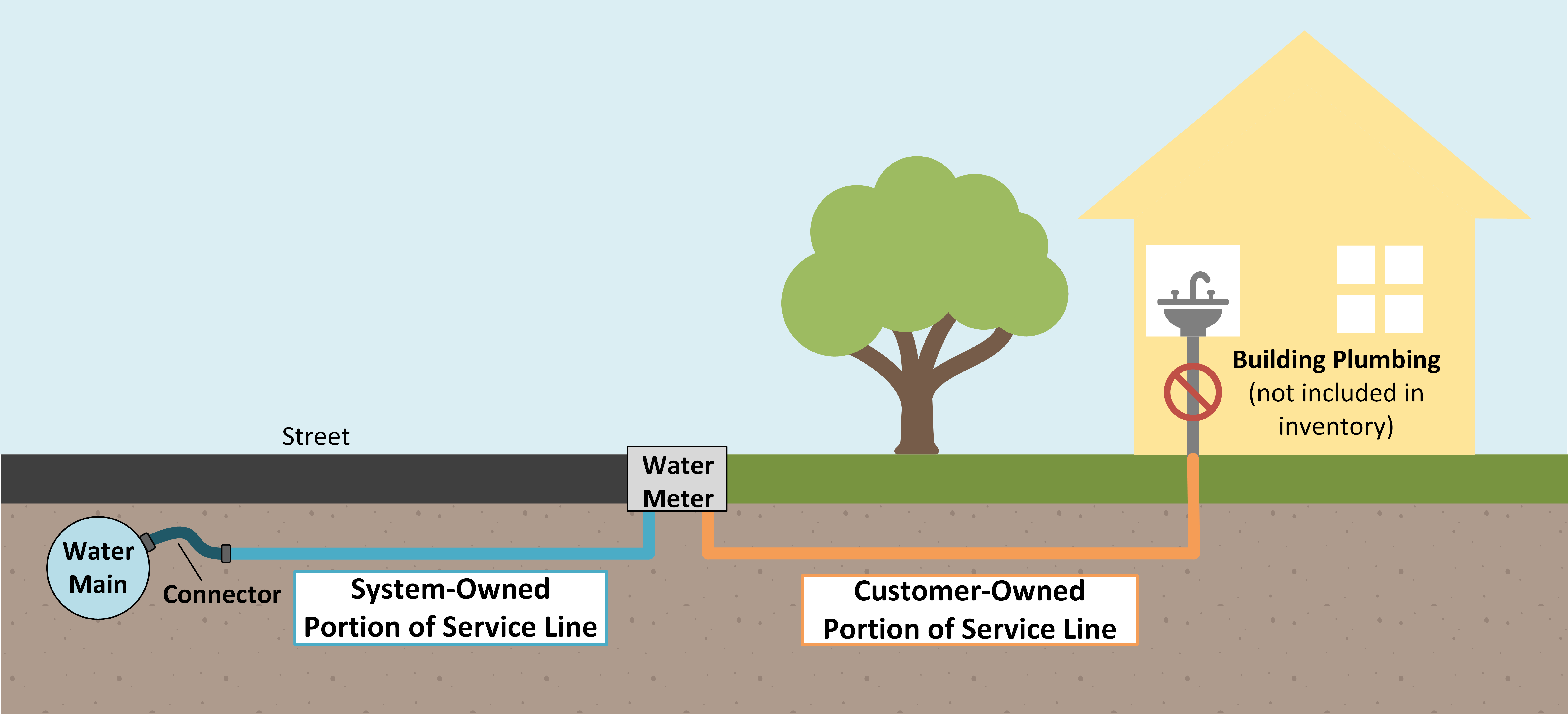 Diagram showing an example of service line ownership in California.
Service Line Material Classification
In instances where there are multiple pipe materials in the service line or if the service line ownership is split between the water system and the customer/consumer, both the system (upstream) and the customer-owned (downstream) portion of the service line must be used to classify the entire service line. Each entire service line in the inventory must be classified into one of the following four materials:
- Lead – A service line where one or both portions are made of lead. These service lines will be included in a replacement plan.
- Galvanized Requiring Replacement (GRR) – A service line where a downstream portion is galvanized and the upstream portion is (1) lead or was previously made of lead, or (2) of unknown material, or (3) non-lead and the system is unable to demonstrate it was never previously made of lead. In these situations, the downstream galvanized pipe can (or potentially) adsorb lead and contribute to lead in drinking water. If the water system is unable to demonstrate that the galvanized portion was never downstream of a lead service line, it must presume there was an upstream lead service line. These service lines will be included in a replacement plan.
- Lead Status Unknown (LSU)/Unknown – A service line where one or both portions are of unknown material. Water systems will continue to identify unknown service lines and provide updated inventories.
- Non-lead – A service line that is determined to be made of a non-lead material and not GRR through an evidence-based record, method, or technique. Non-lead service lines are typically copper, plastic, or galvanized iron/steel not needing replacement. Water systems with records of service line installation dates occurring after the 1/1/1986 California lead ban or records of service lines measuring 4 inches or greater in diameter were allowed to designate those service lines as non-lead.
Note: The reclassification of service line materials may occur as water systems perform additional research and field operations. Contact your water provider if you have questions about your service line.
Summary of Statewide Inventory Data
4,022 of 4,309 have reported inventories
Below is a summary of the total material types reported across the state.
| Entire Service Line Material Type | Total Reported Service Lines | Percentage of Total |
|---|---|---|
| Lead | 0 | 0% |
| Galvanized Requiring Replacement (GRR) | 12,493 | 0.1% |
| Lead Status Unknown | 694,610 | 6.9% |
| Non-lead | 9,389,048 | 93% |
| Total | 10,096,151 |
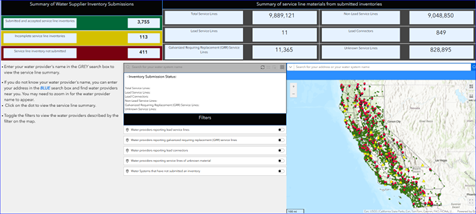
The California Service Line Inventory Summary has an interactive map and dashboard.
(last updated 8/1/2026)
Data Files and Instructions
The inventory data and data dictionary are available to download below. Spreadsheet programs such as Excel cannot handle the number of records in the files, and it is recommended that you download the files and import the data into a database software program such as R or Python. The data dictionary provides definitions and descriptions of the possible data elements you may see in the inventories. The inventory data text files are organized by county as follows using the 2-digit county number:
- SrvLineCA01-CA18 - Alameda (01), Alpine (02), Amador (03), Butte (04), Calaveras (05), Colusa (06), Contra Costa (07), Del Norte (08), El Dorado (09), Fresno (10), Glenn (11), Humboldt (12), Imperial (13), Inyo (14), Kern (15), Kings (16), Lake (17), Lassen (18)
- SrvLineCA19 – Los Angeles (19)
- SrvLineCA20-CA33 – Madera (20), Marin (21), Mariposa (22), Mendocino (23), Merced (24), Modoc (25), Mono (26), Monterey (27), Napa (28), Nevada (29), Orange (30), Placer (31), Plumas (32), Riverside (33)
- SrvLineCA34-CA38 – Sacramento (34), San Benito (35), San Bernardino (36), San Diego (37), San Francisco (38)
- SrvLineCA39-CA58 – San Joaquin (39), San Luis Obispo (40), San Mateo (41), Santa Barbara (42), Santa Clara (43), Santa Cruz (44), Shasta (45), Sierra (46), Siskiyou (47), Solano (48), Sonoma (49), Stanislaus (50), Sutter (51), Tehama (52), Trinity (53), Tulare (54), Tuolumne (55), Ventura (56), Yolo (57), Yuba (58)
- Inventory Data Dictionary – Supporting file for inventory data
The data reflects the initial inventory data collected from public water systems with an inventory status marked as accepted. Updates, to be posted regularly , may include changes in service line material classifications based on updated information from the water system and the addition of information from recently accepted inventories.
(last updated 4/21/2026)
Notice to Users of the Data
Care should be taken in interpreting the data. The data provided were submitted to DDW by the public water systems and may not be representative of the current inventory or operating status of the public water system. The presence of a known or potential lead service line may not indicate lead contamination of a drinking water supply. User inquiries about inventory data are best addressed by the specific public water system, or by the DDW LCR Unit at DDW-LCR@waterboards.ca.gov.
CA LSLI Dashboard
Quick Links
Contact Us
Please send all lead and copper related communications and inquiries to the DDW LCR Unit at DDW-LCR@waterboards.ca.gov.
Technical Assistance
Help with service line inventory development and funding for service line replacement is available to community water systems and nonprofit non-community systems:
- LSL Inventory Technical Assistance Request Form
- LSL Replacement Funding Program Application packages (App. R)
For more information, please visit the Division of Financial Assistance Lead Service Line Replacement Funding Program page or contact DFA-LSLR@waterboards.ca.gov.
Language Access Services
To request services in any language, click on “Request Language Services” to open the language access form.
The form is available in English, Español (Spanish), Tagalog, 中文 (Simplified Chinese), 한국인 (Korean), Tiếng Việt (Vietnamese), ਪੰਜਾਬੀ (Punjabi).

