California Water and Wastewater Arrearage Payment Program(s)
The California Water and Wastewater Arrearages Payment Program has concluded. The State Water Resources Control Board is finalizing the program’s closeout by archiving legacy materials and maintaining only essential resources within the Quick Links section. Final results documents will remain available to ensure continued public access to key program information.
The program no longer accepts the return of previously disbursed funds, and no further reporting-related documentation will be received. Pursuant to Health and Safety Code Section 116773.8, Chapter 4.7, Water and Wastewater System Payments Under the American Rescue Plan Act of 2021, became inoperative on July 1, 2026. As a result, any excess funds must now be resolved independently by water and wastewater systems, and all program figures are considered final.
In total, the California Water and Wastewater Arrearages Payment Program delivered more than $733 million in assistance to over 1.7 million residential and commercial customers, providing critical relief during the COVID 19 pandemic. The program’s success reflects a remarkable, statewide effort — built and launched with unprecedented speed following the enactment of the statute on July 22, 2021, with the first application received October 1, 2021, and first payment issued October 28, 2021.
This achievement would not have been possible without the collaboration of the Division of Financial Assistance, the Division of Drinking Water, the Division of Water Quality, the Division of Administrative Services, the Division of Information Technology, the Office of Research, Planning, and Performance, the Office of Public Engagement, Equity, and Tribal Affairs, the Communications Office, the Executive Office and the State Water Board Members, whose commitment ensured fast, effective implementation.
See the full breakdown below.
Program Results
These are the finalized results of the Water Arrearage Program, Wastewater Arrearage Program, and Extended Arrearage Program as of July 1, 2026.
- Federal Award Information and Compliance Requirements - Fact Sheet
- Federal Award Outputs and Outcomes
- Total Results of the Programs
The Drinking Water Arrearage Program and Extended Arrearage Program included 1,243 participating community water systems, serving an estimated 37.5 million of California’s 39 million residents — a 96% participation-based coverage rate.
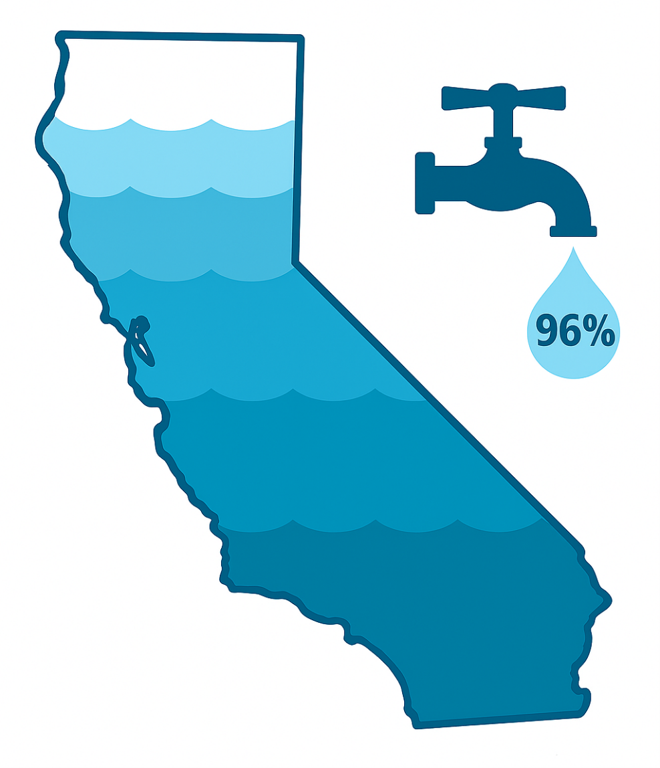
Population estimates are based on residential service connections reported through the State Water Board’s Electronic Annual Reports (eAR), multiplied by average household size from U.S. Census data.
Comprehensive Program Timeline
The Water and Wastewater Arrearage Programs progressed through several distinct phases between 2021 and 2026, beginning with statewide data collection and system surveys, followed by rapid launch, full program administration, extended funding allocations, and final closeout activities. The timeline below summarizes the key milestones and statutory triggers that shaped the program from initial assessment through completion.
Phase 1: Pre-Program Assessment (Early—Mid 2021)
Before the Arrearage Programs were established, the State Water Resources Control Board (State Water Board) conducted a statewide assessment to understand the financial impacts of the COVID-19 pandemic on drinking water systems. In early 2021, community water systems were surveyed to report outstanding residential and commercial drinking water arrearages, along with enterprise revenue loss tied to pandemic-related disruptions.
The survey results identified nearly $1 billion in drinking water debt and revenue loss statewide, revealing financial impacts far greater than individual systems could manage without external support. These findings played a central role in shaping the State’s response. Based on the reported arrears, Governor Gavin Newsom approved the 2021 California Budget Act, which appropriated $985 million in federal American Rescue Plan Act (ARPA) funding to create a statewide water arrearage relief initiative.
The data gathered during this assessment informed statutory development, program eligibility criteria, and the structure of disbursements that would later become the Drinking Water, Wastewater, and Extended Arrearage Programs.
Key Milestones:
- Drinking water arrearage and enterprise revenue-loss survey distributed early 2021
- Nearly $1 billion in statewide drinking water arrears and revenue loss identified
- $985 million appropriated through the 2021 California Budget Act
- Program framework and eligibility rules developed based on survey results
Phase 2: Statute Enactment and Program Guideline Development (Mid-Late 2021)
The program’s development phase began on July 22, 2021, when the statute took effect and set in motion an exceptionally accelerated set of requirements under Health and Safety Code CHAPTER 4.7. Water and Wastewater System Payments Under the American Rescue Plan Act of 2021. Within 90 days, the State Water Board was required to survey community water systems, quantify statewide drinking water arrearages and revenue shortfalls, adopt formal program guidelines, and begin accepting applications.
To meet these statutory deadlines, the State Water Board initiated a statewide arrearage and revenue-loss assessment on August 11, 2021. Community water systems were asked to report residential and commercial drinking water arrearages and water-enterprise revenue shortfalls accumulated during the COVID-19 pandemic bill-relief period from March 4, 2020 to June 15, 2021. By the close of the survey window on September 10, 2021, approximately 80% of systems had responded, documenting $315 million in drinking water arrearages and an estimated $8.3 million in arrears from non-responding systems, establishing a statewide need of roughly $333 million, which includes Administrative Costs.
During this period, program staff prepared the Program Guidelines required by statute. These guidelines provided the structure for eligibility, documentation, disbursement processes, and reporting obligations. They were adopted on September 21, 2021 through a publicly noticed Board Resolution, completing one of the most significant statutory milestones leading up to program launch.
To ensure water systems were prepared to participate, the State Water Board conducted a series of public informational webinars and a workshop, offering guidance on arrearage reporting, program guidelines, documentation requirements, and the upcoming application window mandated to open within 14 days of guideline adoption.
By late September, the State Water Board had completed all major development tasks required under statute—surveying systems, establishing reimbursement criteria, adopting guidelines, and preparing the application process—positioning the program for launch in early Fall 2021.
Key Milestones:
- July 22, 2021 — Arrearage statute enacted
- Aug 11 – Sep 10, 2021 — Statewide arrearage and revenue-loss assessment conducted
- ≈ $333 million Statewide drinking water arrearages plus admin costs identified
- September 21, 2021 — Program Guidelines adopted by Board Resolution
- Aug - Sep 2021 — Public webinars and workshop conducted
- Statutory deadlines met, enabling Program Launch
Phase 3: Initial Drinking Water Program Development and Launch (2021-2022)
Following Board adoption of the Program Guidelines on September 21, 2021, Health and Safety Code § 116773.4 required the State Water Board to begin accepting applications from community water systems within 14 days. This statutory deadline created an exceptionally rapid implementation window, requiring multiple program components to be fully built in a matter of weeks rather than months.
Between the statute’s enactment on July 22, 2021 and the opening of the application period in early October, the State Water Board completed nearly all program infrastructure necessary for statewide launch. This work included hiring program management and onboarding core staff, developing internal procedures, creating program documentation, building an application portal capable of receiving and processing arrearage submissions, establishing a database to store and track incoming data, and constructing the public-facing webpage to house all program materials and guidance. Staff were also trained on application review protocols, eligibility determinations, disbursement calculations, and statutory compliance obligations—ensuring the program could operate smoothly once applications opened.
The application period officially began in early October 2021, within the 14-day statutory requirement. The first application was received on October 1, 2021, marking the start of statewide arrearage relief operations. Under § 116773.4(c), the State Water Board was required to begin disbursing funds no later than November 1, 2021, a deadline the program met ahead of schedule by issuing its first payment on October 28, 2021. All drinking water arrearage payments were fully processed and disbursed by the statutory deadline of January 31, 2022.
These achievements—completed under strict statutory timelines—represented one of the fastest statewide launches of a financial relief program in State Water Board history and laid the foundation for expansion into wastewater arrearage relief in the following phase.
Key Milestones:
- September 21, 2021 – Program Guidelines adopted via Board Resolution
- Early Oct 2021 – Statutory requirement to begin accepting applications within 14 days
- October 1, 2021 – First application received
- October 28, 2021 – First payment issued (ahead of November 1 deadline)
- January 31, 2022 – All drinking water payments fully disbursed per § 116773.4(c)
Phase 4: Wastewater Program Development and Launch (Late 2021—2022)
Following the close of the initial 60-day drinking water application period on December 1, 2021, the State Water Board finalized the results of the Drinking Water Arrearage Program. A total of 582 applications were processed, representing 837 community water systems, and more than $294 million in assistance was disbursed to help residential and commercial drinking water customers address past-due bills incurred during the official COVID-19 pandemic bill-relief period. Although community water systems also reported water-enterprise revenue losses, these amounts were not approved by the Department of Finance and therefore were not eligible for assistance.
Under Health and Safety Code § 116773.4(b)(4)(B), if sufficient funds remained after drinking water arrearages were reimbursed, the State Water Board was required to develop and launch a wastewater arrearage relief program — and to begin that program no later than February 1, 2022. With available funding confirmed, the State Water Board proceeded rapidly to build a fully separate wastewater relief effort within the narrow statutory timeframe.
During the short window between December 1, 2021 and the legislatively mandated launch date, staff built an entirely separate set of program infrastructure for wastewater entities. This work included creating a dedicated wastewater application portal, drafting wastewater-specific Program Guidelines, obtaining Board approval for those guidelines, developing internal review procedures, training staff in wastewater eligibility and documentation requirements, and establishing an internal database to track wastewater arrearage submissions and payment activity. The State Water Board also held public workshops during this period and accepted public comments on the draft wastewater program materials, ensuring that wastewater systems and stakeholders had a clear opportunity to provide input prior to program launch.
The wastewater program opened in early 2022 and received 242 applications, representing 310 wastewater entities across California. More than $131 million in assistance was disbursed to help residential and commercial wastewater customers resolve past-due balances from the COVID-19 pandemic bill-relief period. The final payment was issued on May 13, 2022, concluding all statutory wastewater assistance activities under the program.
Key Milestones:
- December 1, 2021 — Drinking water application period closes
- Drinking water assistance results finalized: 582 applications, 837 systems
- Over $294 million in drinking water assistance disbursed
- Statutory requirement: wastewater program must start by February 1, 2022
- Wastewater portal, guidelines, procedures, staff training, and database developed
- 242 wastewater applications representing 310 entities statewide
- Over $131 million in wastewater assistance disbursed
- May 13, 2022 — Final wastewater payment issued
Phase 5: Initial Reporting Phase (2022—2023)
While the State Water Board was reviewing applications, disbursing assistance, and simultaneously developing the wastewater arrearage program, staff were also required to build the entire reporting framework mandated under the arrearage statute and Program Guidelines. Reporting development had to begin early, because community water systems were required by law to complete multiple follow-up steps soon after receiving funds.
Under Health and Safety Code § 116773.4(d), any community water system that received arrearage assistance was required to credit all eligible customer accounts within 60 days of receiving funds. To support compliance with this requirement, the State Water Board developed reporting documentation, review tools, and a follow-up process to confirm that customers had been credited and that systems had allocated funds correctly. Staff monitored crediting activity and contacted systems when confirmation or clarification was needed.
During this same period, the State Water Board also built a dedicated reporting portal, created an internal database to store reporting submissions, and wrote detailed internal procedures so staff could consistently review reports, verify credit allocations, track deadlines, and monitor the use of assistance. Program staff received specialized training on reporting timelines, documentation standards, reconciliation rules, and follow-up protocols to ensure accurate and timely oversight.
The Program Guidelines required systems not only to complete reporting, but also to return any unused assistance within six months of receiving funds. To support this requirement, State Water Board staff tracked each system’s six-month timeframe, followed up with systems approaching their deadlines, and provided one-on-one help when needed. Many community water systems, especially smaller agencies with outdated or non-automated accounting systems, needed assistance reconciling accounts and producing accurate reporting documentation. Staff offered individualized support, helping systems interpret arrearage data, reconcile allocation records, and complete compliance steps.
Throughout the reporting phase, the State Water Board held public webinars and workshops to answer questions, demonstrate reporting procedures, and provide guidance to systems completing their required documentation. These sessions ensured that agencies statewide had an opportunity to receive assistance, ask questions, and prepare for required reporting deadlines.
By mid-2022, reporting oversight had become a central operational function of the program, ensuring that assistance reached customers properly, unused funds were returned on time, and statutory requirements were fully satisfied.
Key Milestones:
- Reporting framework built while program operations were underway
- Reporting portal, documentation, procedures, and database created
- Staff trained to review and verify reporting submissions
- Verification that customer credits were issued within 60 days
- Tracking six-month reporting and unused-fund return requirements
- Individual assistance provided to systems with accounting challenges
- Public webinars and workshops conducted for reporting support
Phase 6: Extended Arrearage Program Development and Launch (2023—2026)
Following the completion of the drinking water and wastewater arrearage programs in 2022, the State Water Board evaluated the remaining federal American Rescue Plan Act (ARPA) funds to determine whether additional assistance could be provided. The Legislature subsequently amended the arrearage statutes through Senate Bill 122, which was approved by the Governor on July 10, 2023. The amendments expanded the allowable COVID-19 bill-relief period through December 31, 2022, and allowed eligible systems that did not participate in the original 2021–2022 program cycles to apply for assistance covering that earlier period.
Because the original program management team and staff had been hired under temporary two-year positions and had already transitioned out of the program, the State Water Board needed to hire an entirely new management team and staff to administer the Extended Program. With new personnel onboarded, staff began developing updated procedures, revising documentation, and building a fresh round of program infrastructure.
The State Water Board drafted new Extended Program Guidelines, reflecting statutory changes, updated eligibility criteria, the expanded bill-relief period, and requirements applicable to both water and wastewater entities. These guidelines were adopted by the Board on October 3, 2023, providing the legal framework to launch the extended assistance cycle. During this time, the State Water Board held additional public workshops and accepted public comments to ensure systems had the opportunity to review and provide input on the new program materials.
Drawing on operational lessons learned from the initial arrearage programs, the Water Board created a streamlined combined application covering both drinking water and wastewater arrearages in a single submission. Staff updated the application portal to support the integrated process, expanded internal databases, and trained reviewers on the revised documentation and eligibility requirements.
The Extended Arrearage Program opened in late 2023, with the first application received on November 1, 2023. Most applications were submitted by January 31, 2024, though a small number of additional submissions were accepted afterward due to eligibility expansions under SB 122.
The Extended Program received over 240 applications, representing 406 community water systems and 215 wastewater entities statewide. More than $301 million in drinking water assistance and $136 million in wastewater assistance were disbursed. The first payments were issued on February 16, 2024, and all disbursements were completed by May 8, 2024.
As with the prior program cycles, the Extended Program required reporting and account reconciliation. Although this reporting phase followed similar processes as earlier arrearage programs, it was administered in a more streamlined manner due to updated tools, clearer documentation, and stronger system preparation. Once extended-program reporting concluded, the temporary staff and management transitioned to other assignments. The State Water Board then performed final data cleanup and internal review for all three programs, working closely with funding recipients to ensure accurate reporting and the return of any inadvertently ineligible funds.
Key Milestones:
- July 10, 2023 – SB 122 approved; bill-relief period extended through Dec 31, 2022
- New management and staff hired to administer the Extended Program
- New Extended Program Guidelines developed and adopted Oct 3, 2023
- Additional public workshops and comment opportunities held
- Streamlined combined drinking water/wastewater application created
- Nov 1, 2023 – First extended-program application received
- Most applications submitted by Jan 31, 2024
- Over 240 applications processed (406 water systems; 215 wastewater entities)
- $301 million in drinking water assistance disbursed
- $136 million in wastewater assistance disbursed
- Feb 16, 2024 – First extended-program payments issued
- May 8, 2024 – All extended-program disbursements completed
- Streamlined reporting completed
- Final data cleanup and reconciliation performed
Phase 7: Closeout (through July 1, 2026)
As the Extended Arrearage Program neared completion, the State Water Board began the final closeout phase for all arrearage programs—Drinking Water, Wastewater, and Extended. This phase required extensive data cleanup, reconciliation, and oversight to ensure that all funding activity complied with federal subrecipient monitoring requirements under the American Rescue Plan Act (ARPA). Staff reviewed arrearage data, payment records, supporting documentation, and system-level reporting to verify accuracy, identify inconsistencies, and ensure that all eligibility rules had been followed.
During final reconciliation, the State Water Board compiled the overall disbursement totals for all three program cycles:
Disbursement Totals
- Residential assistance disbursed: $742,367,454
- Commercial assistance disbursed: $120,483,447
- Administrative assistance disbursed: $17,973,769
Total disbursement: $880,824,670
Water systems then submitted final reports documenting how assistance had been allocated to customer accounts. After reviewing all reporting data, the Water Board confirmed that:
Credited/Used
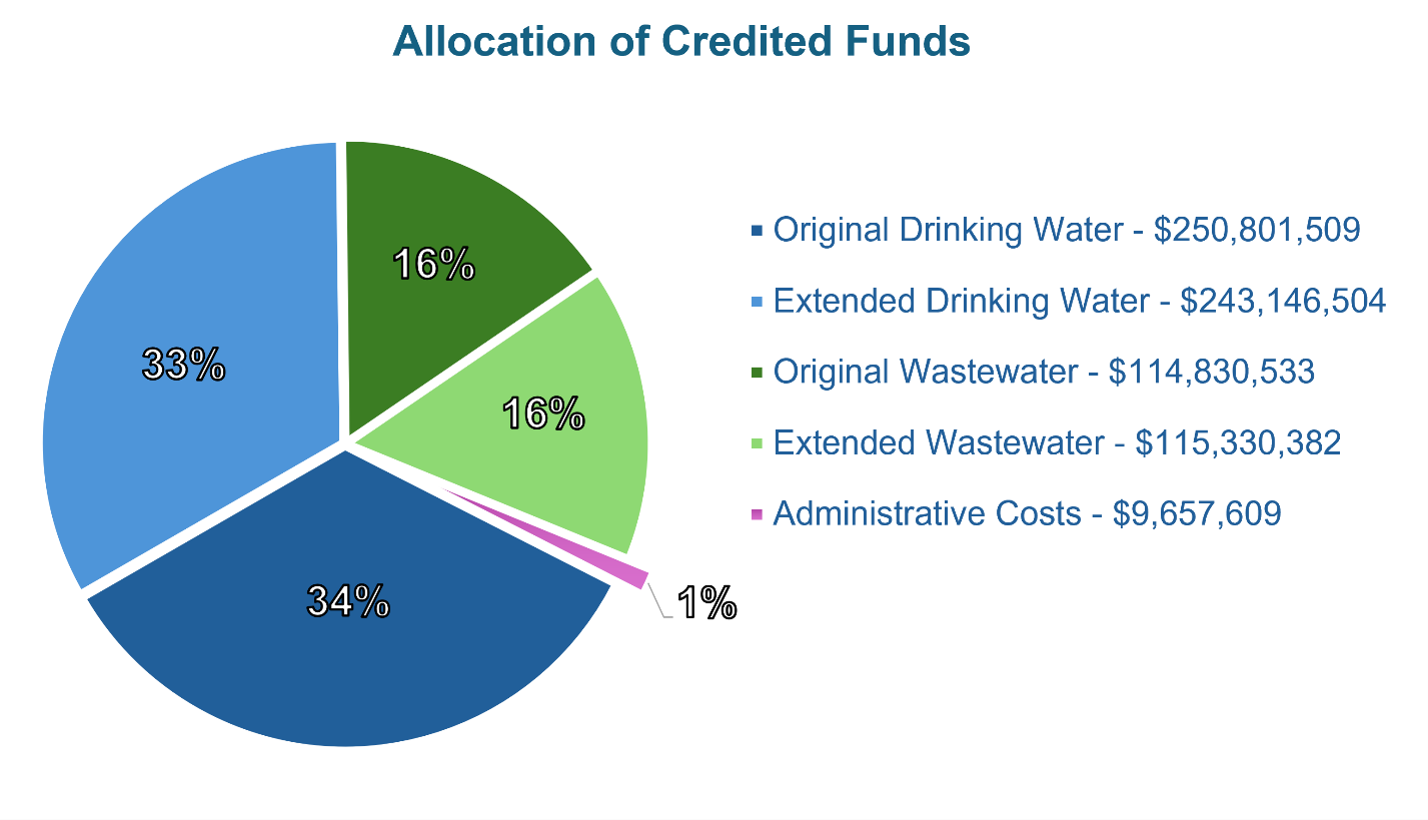
- Residential assistance credited: $627,191,164
- Commercial assistance credited: $96,917,764
- Administrative assistance used: $9,657,609
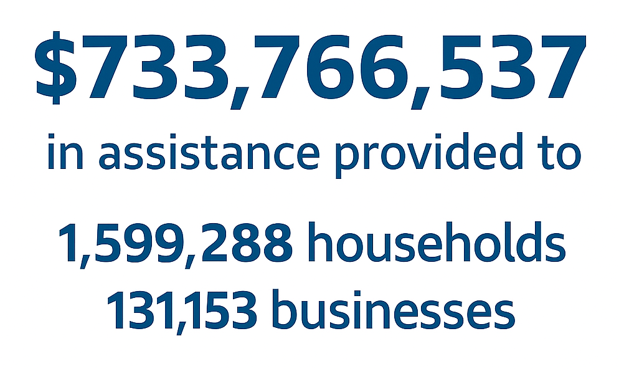
Total credited/used: $733,766,537
The difference—approximately $138.7 million returned—was primarily the result of customers paying down their past-due balances after their water system submitted an application but before the system received its funding and applied the required credits within 60 days. Although the Program Guidelines allowed water systems to apply customer payments to billing periods outside the COVID-19 bill-relief eligibility window to maximize customer benefits, many systems’ accounting software could not support this level of payment designation. As a result, portions of the assistance became ineligible once the customers’ account was no longer past due, requiring systems to return those funds to the State Water Board.
Across all three arrearage programs, assistance ultimately helped 1,599,288 residential households and 114,753 commercial accounts, providing relief for both drinking water and wastewater customers statewide. Administrative funding helped water and wastewater systems navigate complex reporting requirements, data reconciliation, and pandemic-related operational disruptions.
Under the statute, the Arrearage Program became inoperative on July 1, 2026, and no further program operations, reporting, or disbursement activities will occur beyond this date. The Water Board will continue to maintain program records for the period required under state and federal law, but all other program functions have concluded.
Quick Links and Archived Program Pages
Original Water Arrearage Program Page (for reference only)
Original Wastewater Arrearage Program Page (for reference only)
Extended Water Arrearage Program (for reference only)
Fraud, Waste, and Abuse Prevention
Contact
For questions related to archived Arrearage Program materials, please contact: david.deaton@waterboards.ca.gov